As a kid, I was a computer geek. I spent hours playing computer games, of course, but also taking machines apart and trying to put them back together, learning to code, and having lunchtime arguments over operating systems. When Windows 95 dropped, I made sure my dad took me to the midnight launch party at our local CompUSA.
Computers were a hobby, like model airplanes—fun, but not much more. Then, sometime around 1997, I stumbled onto GeoCities. I threw together a page about the Beatles, put a web counter it, and watched the number tick up. Today, it’s commonplace for ordinary people to reach a global audience, but for a middle schooler in the late 90s, it was a revelation. I’d made something in our suburban house, over our dial-up Internet connection, and within minutes people in unknown parts of the world had seen it. That wasn’t a game. It was a kind of self-expression I hadn’t expected from the beige box in my parents’ home office.
Since then, I’ve loved technology’s capacity to expand what’s possible for ordinary people, and that’s what eventually led me to a career in the industry. Still, until recently I hadn’t had that feeling of possibility again, like I did back then. The computing technologies that arrived over the years, including several I’ve had a chance to work on, have been remarkable, but always seemed like the continuation of revolutions that began in the last century.
Now, I have that feeling again. The future is starting to crack open, because AI is the most significant technological development in generations, and perhaps in centuries.
I don’t say this lightly. A major part of my job at Microsoft was understanding technology trends, and in particular filtering out hype, and after nearly a decade in the industry, I’m skeptical of “next big things.” There are plenty of overheated claims about AI right now, but there is something very real underneath. You don’t have to get sucked into tortuous debates about whether AI is really “intelligence,” when it might meet an ever-shifting definition of Artificial General Intelligence, or whether it poses an existential threat to humanity to see AI’s fundamental potential or the profound practical effect it’s already having. It’s been less than three years since the AI race burst into the open with the launch of ChatGPT, and already AI has changed the way millions of people work, communicate, and engage with the world—and that’s only what the public sees. Out of sight, an even more dramatic change is beginning, as AI changes how businesses run their operations, how scientists conduct research, and how engineers develop other breakthrough technologies in every field. Unlike most previous technologies, AI can accelerate its own development: the stronger it gets, the faster it will improve, compounding change in every area it touches. In time, it will touch every part of our lives, directly or behind the scenes. We can’t be sure exactly how or how fast AI will mature, and it’s likely there will be a bubble or two, but we can be sure that this century will be one of accelerating change and reinvention.
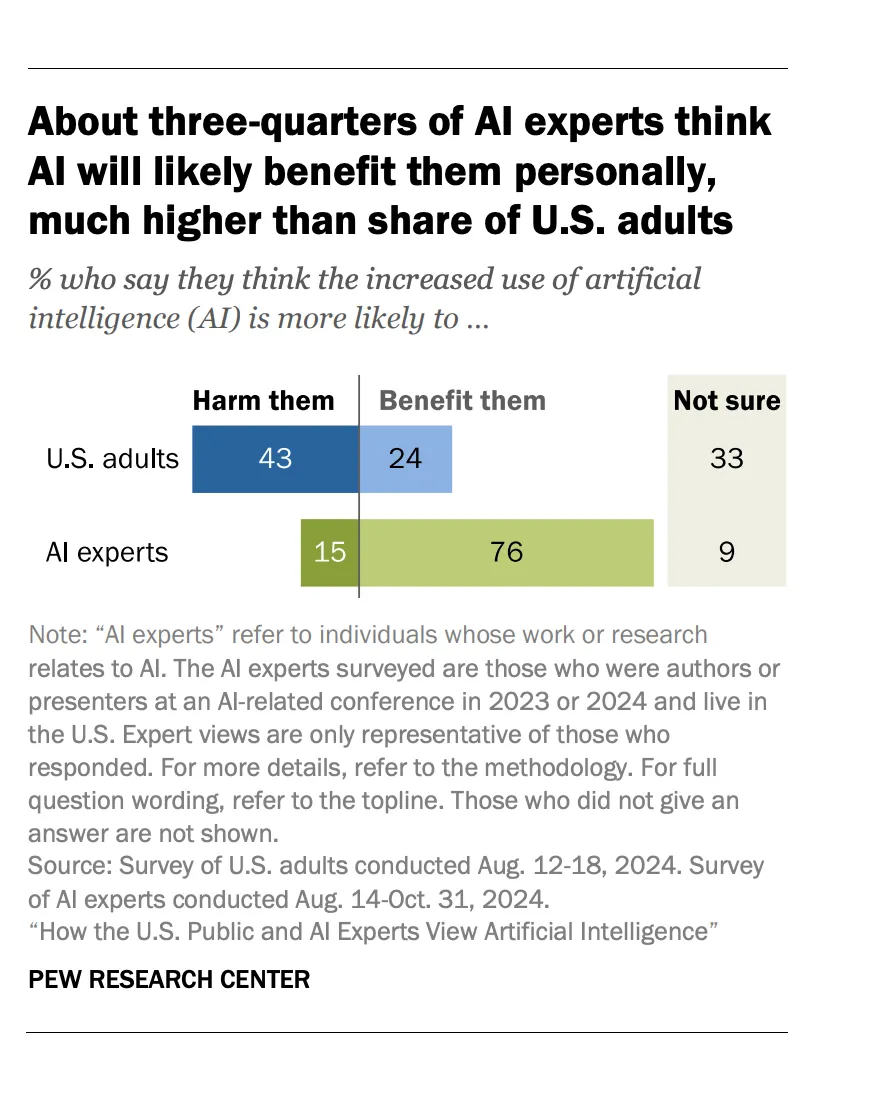
But, not everyone shares that sense of possibility. The chart above shows that the American public is more likely to believe that AI will harm them rather than benefit them. AI “experts” may see AI’s potential benefits—not only private profit, but new medical treatments, an energy transition, richer education, revitalized democracy, broader prosperity, and more. But the public may see the potential harms more clearly: job loss and economic upheaval, rising inequality, environmental devastation, and a range of social and psychological problems. And, AI may seem to most people in the world like something they have no control over, an approaching tidal wave that will wash over them, while they can’t do anything but watch.
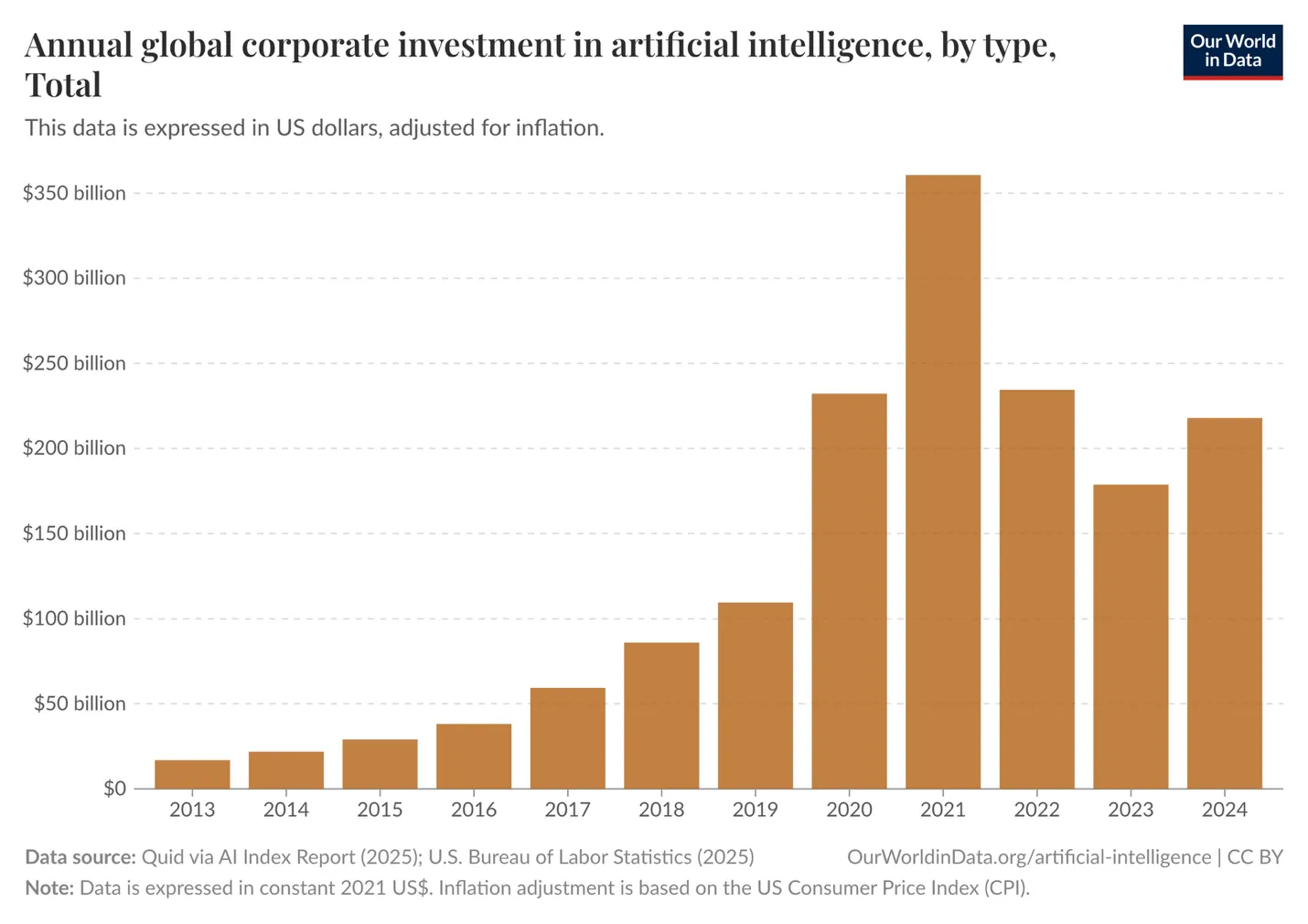
And yet we charge ahead. The chart above shows that over the past decade, global corporate investment in AI has ramped up dramatically, averaging more than $200 billion per year over the last five years. This is plainly the most important area of investment in the world today, to the point that it is reshaping the entire economy.
Something is broken in our civilization when public perception and business investment are so clearly at odds. It is the tragic opposite of that defining moment I experienced with the Internet: instead of seeing a future of greater possibility, many Americans see one in which their prospects—and those of their children—will shrink.
We should close that gap, so that people can see themselves in an AI-driven future. Instead, in our polarized era, we’re stuck in a binary choice between acceleration and responsibility, between those who want to prioritize driving AI ahead and those who want to prioritize addressing its risks. You can see the divide in the approaches to AI from the White House. President Biden’s 2023 executive order put addressing risks first: safety, privacy, equity. In 2025, President Trump rescinded that order and changed direction: speed, investment, and competition with China. Both are right, and both are wrong. It seems increasingly impossible to find a balance, as everyone is forced to pick a side: Team Acceleration or Team Responsibility.
We must reject this choice. I’m not willing to give up on rapid acceleration, and I want as much investment as we can muster in an environment that promotes speed and competitiveness. In part, that’s because I truly believe in the promise of AI: every day we delay is prosperity lost or a life-saving treatment deferred. In part, it’s because we absolutely are in a national competition, one we cannot lose. But, I’m also not willing to see ordinary people trampled as technology surges forward. We need both acceleration and responsibility. We can’t sacrifice either.
We can have both, but we have to approach the problem with imagination and ambition. American companies and research labs are driving AI forward and finding its applications, but it’s the work of government and civil society to align that capability with our shared values—to maximize the benefits and minimize the risks. Getting this right is not just another political issue; it could be the singular issue of the century. We can do it by bringing the same ferocious ingenuity that goes into building AI to the work of aligning it to our values.
Earlier generations of Americans did that. In the nineteenth and twentieth centuries, they saw what industrialization was doing to American society and American people, and they acted: the labor and progressive movements, the Sherman Act, the New Deal, and the creation of regulatory agencies were all efforts to soften the edges of industrialization and deliver its benefits widely. Every one of them was something new, not acts of civil society and government but reinventions of them. Regulatory agencies, for example, are familiar today, but they were invented about a century into the country’s life. Americans realized that Congress and the courts were too slow, too inexpert, and too susceptible to influence to manage an industrial economy, so they created agencies staffed by experts, insulated from political pressure, and granted the authority to set rules, enforce them, and adjudicate disputes.
Like them, we can’t be satisfied to muddle through with the tools we have. We need new tools with the immediacy and flexibility to keep up with AI. For example, the current way we make regulation—defining clear rules through a deliberative process and enforcing them in court—was invented to govern railroads, not an industry that moves from cutting-edge academic research to real products in a few months. There are areas ready for clearer rules, like age restrictions to protect minors, but at the frontier, traditional regulation will either fall behind the industry or force it to slow down.
Instead, we can find new ways to bring public participation into AI. There are already explorations in bringing public input into the way AI models are developed. These lay a foundation for a proposal I’ve worked on: adding public representatives to the boards or senior leadership teams of companies building major products in the AI “stack,” whether they build silicon chips, cloud infrastructure, new AI models, or critical applications. Those representatives could be appointed by an agency and would have a staff who would be spread throughout the company. They would not have binding authority, but could observe and provide input on critical decisions in real time and provide transparency to the public in extraordinary cases. They would help companies align their work to the public interest without imposing rules and restrictions that inhibit progress and, as the industry matures, the findings of these representatives could inform more traditional regulation and safeguards. Representatives would shift the public’s relationship with technology, so that instead of being in the back seat (or standing in the path of the car), we can help steer. The bargain with private companies is that, while there will be new people in the conference room, they would avoid onerous rules that could slow them down.
That’s one idea, but we need many more. How are we going to prepare future generations of students to make and work with AI, and at minimum be literate in understanding its effects? How are we going to create more faster and more flexible higher education so that people’s careers can adapt as the market develops? There are practical challenges to consider in any of these areas, but they are solvable. If humanity has the capacity to create an entirely new form of digital intelligence, we must be able to solve the easier problem of updating our approach to regulation.
To get to the world we want, I plan to advance an agenda for American AI that achieves both acceleration and responsibility, so that we can win the race on our terms. That agenda focuses on:
Investment: American AI competitiveness will depend on sustained, large-scale public investment, alongside reforms that make private investment easier:
Research: Expand federal support for fundamental research, from core computer science to applied studies in areas like health, energy, and security. Public funding should prioritize cross-disciplinary collaboration and cross-sector partnerships, ensuring breakthroughs are widely shared
Infrastructure: Clear obstacles to private investment in advanced computing capacity and secure digital infrastructure, while ensuring broad access for universities and public institutions
Critical industries: For example, semiconductors and specialized chips
Openness: To lead in AI, the United States must stay open to the world while ensuring a fair, competitive market at home:
Open markets: Keep trade and collaboration open so American AI firms can sell into global markets, take advantage of international supply chains, and benefit from international partnerships
Talent: Recruit the best minds from around the world to study, research, and work in the United States
Competition: Preserve active competition, particularly to allow startups and other new entrants to innovate and compete
Participation: Experiment with and implement systems like publicly-appointed representatives so that public values can be incorporated in AI development without burdening innovation at the cutting edge.
Safety: Some basic requirements are clear enough that we can create more traditional clear-cut regulations today. For example, we can require from consumer-facing products:
Restrictions on use by minors
Basic security and privacy standards
Clear mechanisms for users to report issues and procedures for addressing them
Readiness: Every American should have the opportunity to participate in the AI economy. That means:
Education: Equip K–12 schools with resources and curricula to teach AI literacy, ensuring the next generation can not only understand these technologies but build with them.
Higher education / skilling: Flexible and affordable career development programs that allow workers to adapt to new industries and opportunities as they emerge. Create a market for these programs by giving employers incentives to consider them in hiring.
If we approach this moment with ambition and imagination, America can stay at the forefront of progress without losing sight of our values. If we get it right, AI can open entirely new possibilities for all of us.