A couple of weeks ago, when the news about the DoD, Anthropic, and then OpenAI landed, I rushed to post about it online. This was exactly the kind of story that I wanted Complicity Navigator to capture: one company sacrificing its principles to the Trump Administration, the other standing firm and putting its future on the line. I wanted to be a part of telling and responding to that story.
It was clear pretty fast that I had nothing to add. The story was the top trending topic, and my feed was saturated with recaps and takes and videos and explainers and all the rest of it. Anthropic’s chat application, Claude, even surpassed OpenAI’s ChatGPT. I could toss a few points in here and there, but usually somebody else would have already said essentially the same thing.
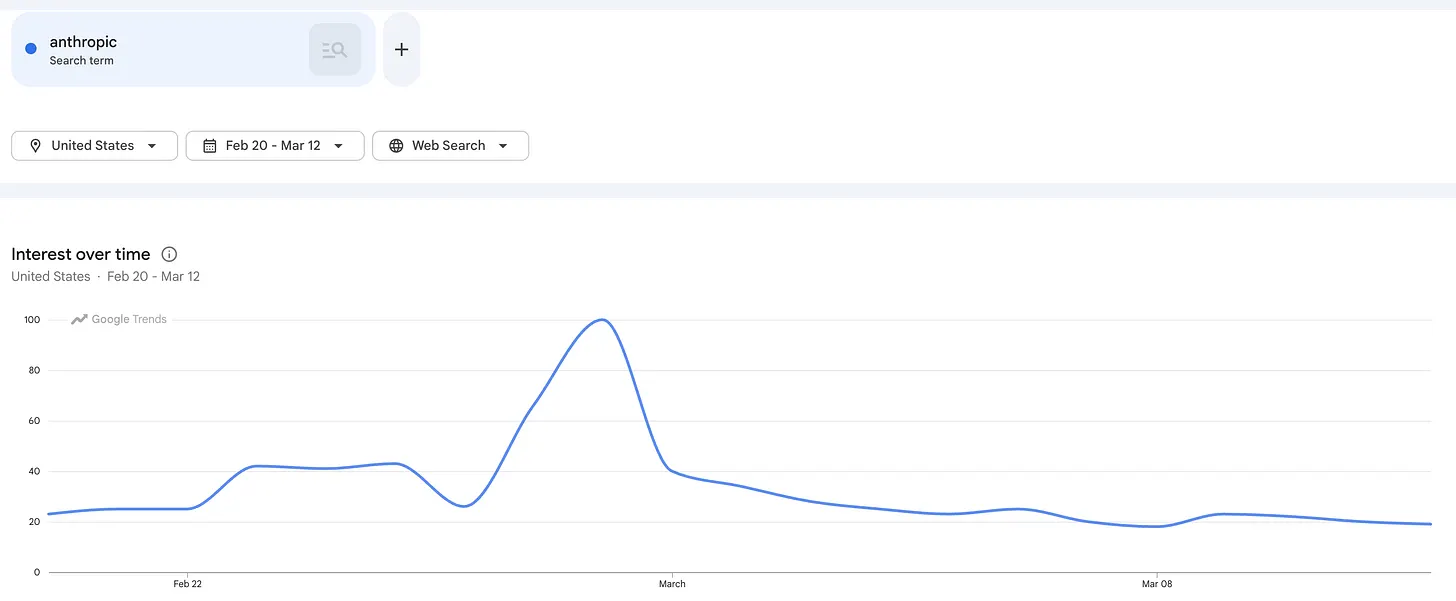
And then the next day, the United States attacked Iran and the Anthropic story was knocked out of the top position. It isn’t gone, but it certainly isn’t top of mind for the public. A leading corporation in the most critical field of the century defied the Trump Administration over serious matters of principle and public safety and an unscrupulous competitor stepped in to replace them, and within two days the public’s attention had moved on.
Here’s the Google search trend in the US for Anthropic over the past week:
And to put it in perspective, here is the same chart with interest in Iran overlaid.
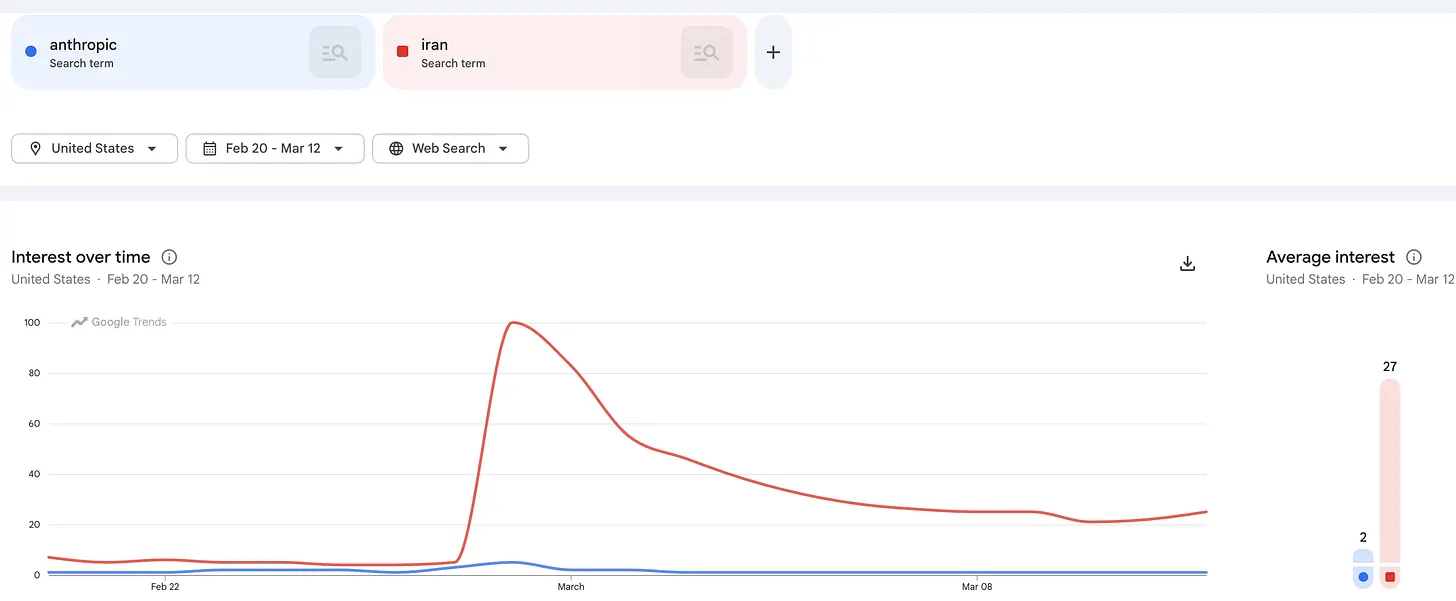
Anthropic has flatlined; public interest is where it was before the event began. The commentariat is still thinking about it, but the public isn’t.
Just for fun, here’s the year-to-date view with “Venezuela” and “Minneapolis” included:
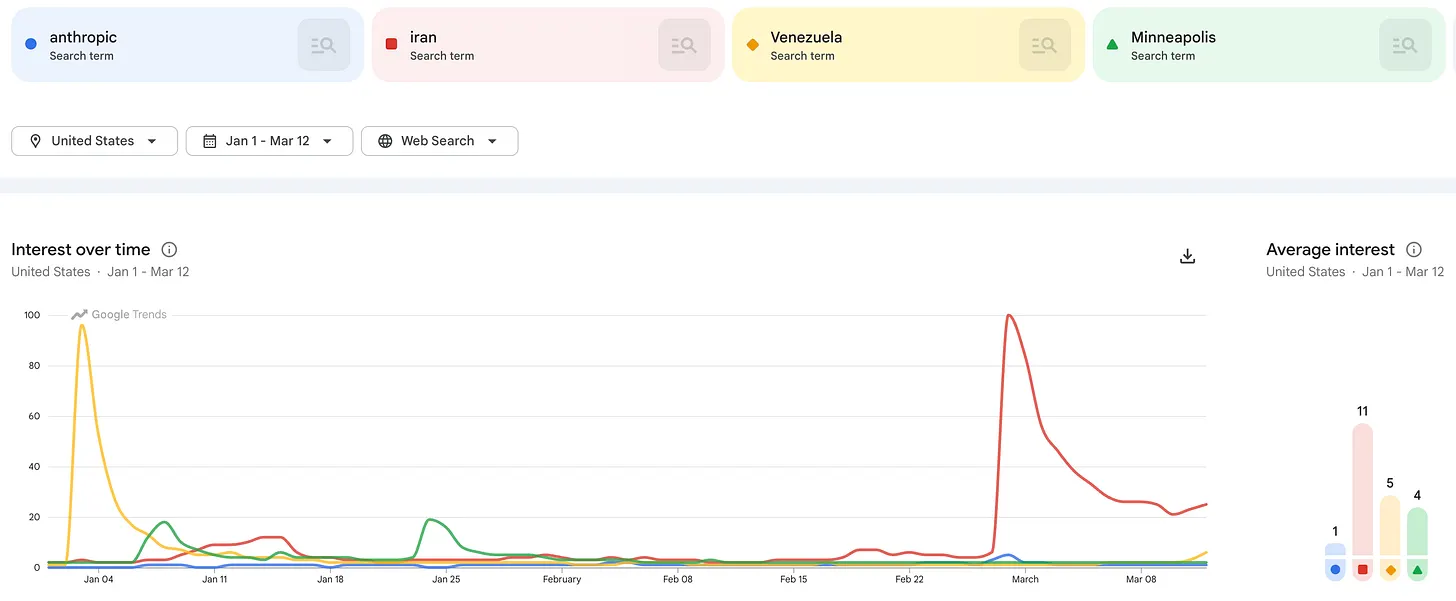
The President’s actions in Venezuela were unprecedented and led to a chorus of calls for impeachment: this was supposed to be a turning point for the Trump presidency. You can see the spike in the yellow line that came and went.
Renée Good and Alex Pretti were murdered on the streets of Minneapolis; their deaths shocked the conscience of the nation. You can see the bumps in the green line. They are not forgotten, but they aren’t at the front of the national consciousness like they were.
The public moved on to the next story, and the press followed them there. This time, last time, the time before that, and next time too.
Iran seems today to be the most important story; how could it not be? But if I had to place a bet, I would say that within a few months, and perhaps much sooner, that red line will be flat and we’ll have a peak in a line with a new color.
Living in the Shepard Tone
A Shepard Tone is an auditory illusion that sounds like a tone that is constantly rising (or falling), but never actually changes. Listen:
The effect is disorienting, anxiety-inducing. It is constant crescendo without resolution or relief. First, you feel confusion when the tone never seems to go anywhere. Then, you feel dread when you realize it will go on like this forever.
We live inside a Shepard Tone now. The catalogue of things that happened in just the first 60 days of this year is impossible to comprehend; the things I mentioned above do not even include, for example, the weeks when the President was openly musing about dissolving NATO, attacking Denmark, and annexing Greenland.
When talking about this phenomenon, most people talk about distraction, but that’s not right. “Distraction” implies some focused state that Trump is disrupting, and it implies the trivial pulling attention away from the substantive. That’s not what’s happening. This “distraction” is persistent and compounding, and each new element is consequential. There is no normal to turn our attention back towards. There is only the next crisis.
It is so disorienting that it changes our relationship with time. First, we are disconnected with the past. Another thing I didn’t mention from the list above: the President launched a criminal inquiry into Fed Chair Jerome Powell that led to Powell releasing an unprecedented video addressing the attacks on him.
That was a major event in American history, and in less than two months nobody is talking about it. I would guess that even many of us trying to stay on top of what’s happening haven’t thought about it for weeks. The pace of news doesn’t allow it.
Second, we are disconnected with the future. There is a widespread resistance movement, and I’m glad to be a part of it, but while we push back against these abuses, we struggle to break out of the moment. More than a year into this administration, I could not tell you what Democrats want for the future of the country if they win in 2026 and 2028. That’s true of the ones in office, the ones running for office, and the ones voting. I know they want to undo what this administration has done and I know they want to keep chipping away at perennial problems like healthcare, and I’m all for it. But the President and his crew clearly have ambitious plans for what America should look like, and they’re ruthlessly carrying them out. I can’t say the same for us. We should be doing that work, but our attention and energy are consumed by the moment.
In the Shepard Tone, there is no past and no future. There is only an urgent and excruciating present.
Memory and Vision
We can’t keep going like this.
We can’t stop the abuses until we can hold people accountable, and that’s not possible if we so quickly lose focus on what they’re doing. Every CEO and senator knows that Trump holds a grudge but the public forgets, and they plan accordingly.
We can’t inspire a movement for a better future if we are fundamentally reactive. In 2026, voters may send a message of protest to the President in the midterms, and Democrats are ready to provide that. In 2028, they will want leadership, and we aren’t ready to provide that.
We need an escape from the present. That means two things: memory and vision.
Memory: I realized that the time to say something valuable about Anthropic and OpenAI was not that Friday, amid the crush of commentary. It will be in three months, or a year, or five years, when our attention has moved on. And then what will be valuable is not a hot take but simply a reminder. People will behave more accountably today if they know that their actions will be remembered tomorrow, that they can’t hide in our forgetting.
Vision: The MAGA vision is not hard to articulate. To its proponents, it’s a country that’s simpler, more familiar, and more comfortable, because it’s more homogenous. Traditional social norms and categories are enforced. New people and ideas that complicate, confuse, and contaminate things are kept out. America looks out for itself instead of throwing our resources away on people, at home and abroad, who should take care of themselves. And if we do all that, we can fix the problems that plague us. It’s a powerful story, even if it is foolish and cruel at its core. As I’ve argued here before, we have nothing to compete.
Two projects
I’ve been spending time on two projects over the last few months, and now I realize why.
Complicity Navigator. Launched in February, it is capturing and organizing the acts of capitulation and complicity (as well as acts of courage) that have extended the power of this president. I want it to be the memory that lasts long after events have left the news.
New American Century. This Substack, initially started as a way to process Trump’s reelection with friends and family, then as a way to publish policy arguments during my campaign for public office. I’ll continue here to try to pull together and articulate what I think that vision should be for the long term.
These are my efforts to mute the Shepard Tone, to step out of the present and reestablish the perspective it will take to move beyond this disastrous era.