I spent the summer before my senior year of college in New Orleans, registering people to vote. I’d never been to the city before and was excited to experience it, particularly at night, and particularly the music. That turned out to be a completely unrealistic expectation. Each day, I spent hours walking door-to-door in the smothering Louisiana heat, and when I finally got home, I’d manage to read a few pages of one of the books I’d brought with me from New York before passing out.
One of those books was Protectionism by Jagdish Bhagwati. I can’t imagine where I got the book, an out-of-print set of lectures on international trade from the late 1980s, or why it earned a place in my suitcase. I was firmly on the left of any political spectrum available, and I might have attended the WTO protests if I’d been old enough at the time. I wasn’t just skeptical of trade or even of capitalism, but of economics itself. I knew it was important, and I’d had The Wealth of Nations and others as assigned reading, but economics seemed like the kind of thing College Republicans—not aspiring civil rights lawyers—studied.
I don’t remember why I had the book, but I remember the effect it had. Bhagwati’s lectures are specifically about trade, but reading them was the first time I made the connection between abstract economic theory and the lives of real people, and how well-intentioned but poorly-conceived policy can ruin lives. How could I say that I cared about economic equality and justice if I hadn’t bothered to understand economics in the first place? I felt foolish that I’d written off such a critical subject.
I’ve been thinking about that book and that experience recently as Donald Trump has destroyed the economy, particularly since trade is a critical part of how he’s doing it. As usual, I’m angry not only at Trump but at a Democratic Party that isn’t rising to the moment.
President Trump is actively sabotaging America’s future
Tariffs are a terrible idea. That’s basic. There might be certain, limited circumstances where some trade protection or retaliation might be warranted, but as a broad baseline, tariffs are terrible.
It’s worth saying that now as citizens and pundits wonder how to make sense of the economy. Trade wars were predicted to harm the economy, but many of the indicators remain OK—”There’s a layer of policy chaos built on top of an economy that seems surprisingly resilient to that chaos.”
But unexpected outcomes don’t mean the basic rules have changed. Sometimes, when fluids are moving in just the right way, an enormous metal machine can leave the earth, but seeing an airplane in flight doesn’t mean we have to throw out everything we know about gravity. When the fuel runs out, the plane is coming down.
Similarly, we know that economies thrive when they’re efficient and productive, and that there are basic drivers of these. Scale: we can do things more efficiently and effectively if we do them many times instead of a few times. Competition: when different people or groups compete, it forces them to either become more efficient and productive or lose. Comparative advantage: Every person, company, and country is better at some things than others, and we’re all better off if we each focus on the things we’re better at.
Tariffs are an attack on all of these and more. By closing our markets to the world (and pushing the world to close their markets to us), we reduce scale, limit competition, and neglect comparative advantage. There might be specific conditions that mask those effects—for example, a runup in AI investment, or companies absorbing increased costs while they expect tariffs to go away—but it can’t last. The Earth orbits the Sun, and economies shrink when they’re closed. There is pain coming, and it will last for generations. Even if we recover to a pre-tariff economy, we will have wasted the opportunity these years would have given us to grow even more.
There’s more than one way a president can fail at managing the economy. The most forgivable is that circumstances are beyond them: a war, or a pandemic, or an unexpected crash that puts economic security and growth out of reach. Next is basic mismanagement and incompetence: trying things that don’t work, failing to act quickly enough, getting the tradeoffs wrong. This administration is something beyond these: active sabotage. The policies that they’re pursuing are unnecessary and destructive. The tariffs alone are enough to make that charge, before we even get to attacks on scientific research, immigration, growth industries, and on, and on, and on.
Democrats are letting the pitch go by
So what are Democrats doing about it?
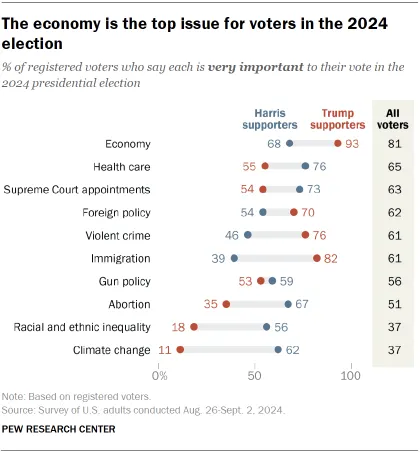
Americans consistently say that the economy is the issue that matters most. In 2024, it was the top overall issue for voters, with 81% saying it would be very important to their vote. That includes 93% of Trump voters, and no other issue came close—immigration, Trump’s signature issue, was named a motivating issue for 82 % of his voters.
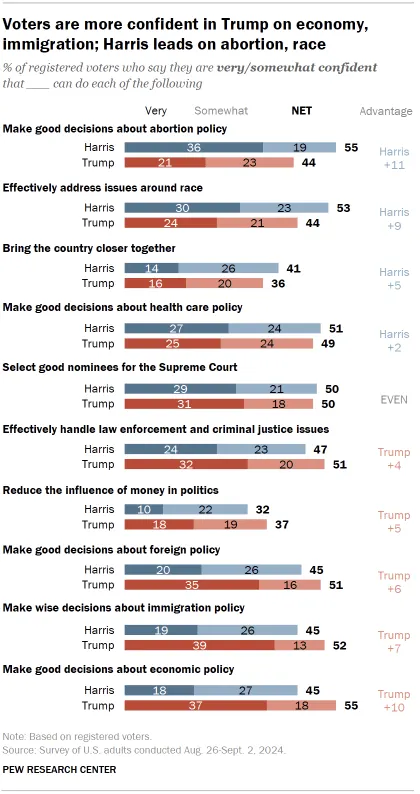
Unsurprisingly, that’s reflected in the confidence voters put in candidates for managing economic policy, where Trump was ten points ahead of Harris.
Republicans have historically—though unjustifiably—had greater credibility on the economy. That’s partly because they’ve been closer to business, and voters believe (somewhat justifiably) that being in business means understanding how the economy works; it wasn’t hard to believe that George H.W. Bush or Mitt Romney would know how to manage an economy. In my lifetime, Democrats have been at least as good and typically better at managing the economy, but we haven’t convinced voters of that.
Now we have a President who is actively undermining the economy, waging wars of choice against foreign nations and American companies and consumers. If there was ever a moment for Democrats to make a definitive case that we are the party of strong economic management and growth, it’s now. Trump’s actions are devastating for the country and the world, but a political gift to his opposition: the most important issue in politics is there for us to take, if we would only go for it.
We are not going for it.
Democrats are not talking about growth. We are not talking about innovation. To the extent we talk about the economy at all, it’s typically about ending abuses by the wealthy—important, but not nearly the whole story. At Democratic candidate forums, I’ve been asked about healthcare, about civil rights, about reproductive rights. These are essential issues, but they’re also the ones Democrats tend to agree on and the ones where we already have the public’s trust (see the chart above—these are the issues where Harris led). I don’t know that I’ve been asked once about a plan for the economy. We do get asked about affordability—but the answers most candidates give are lopsided in favor of public services and regulation, with little to say about the economic vitality that makes those services possible, or that would create greater opportunity. Today, on Mayor Mamdani’s first day in office, I’ll point out that if he can achieve goals like free buses and universal childcare (and I hope he does), it’ll be because of the extraordinary economic base that New York enjoys. Economic growth makes it possible to do all the progressive things we want. It’s not a sufficient condition, but it is a necessary one.
Meanwhile, we distance ourselves from economic growth with statements like this:
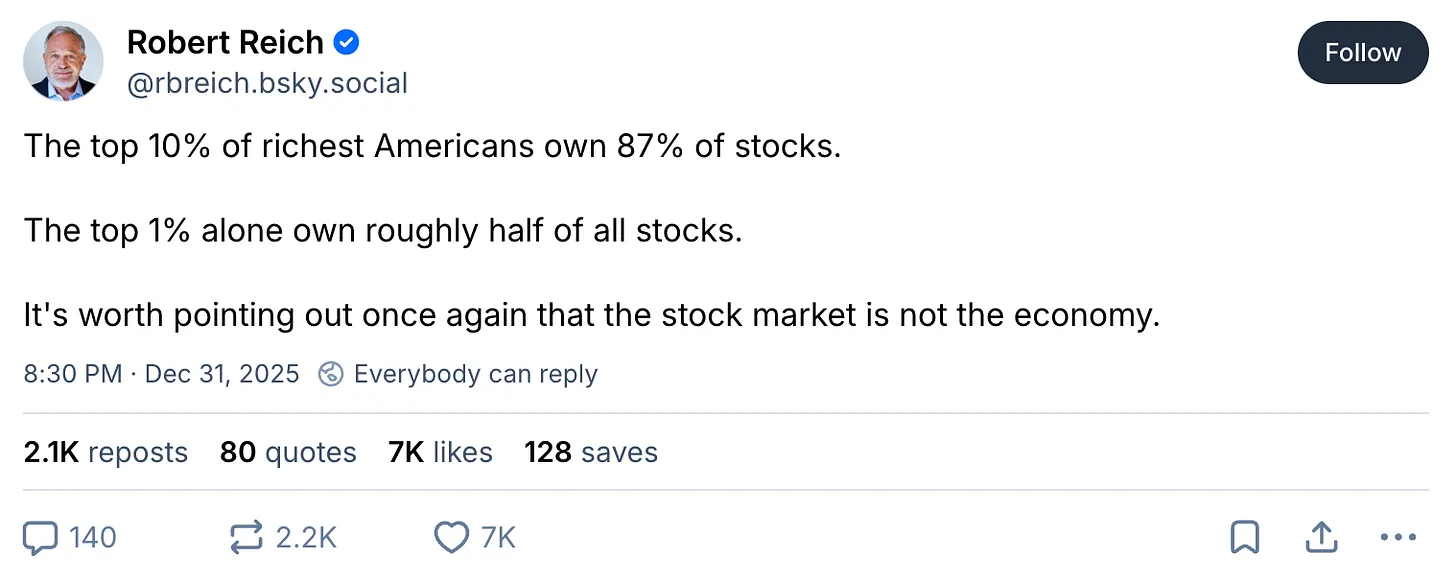
I could not agree more that outrageous inequality is an urgent problem that demands our attention, or that the stock market is overrun by speculation and risk-taking that are dangerous for the economy. But even if the market is not the economy, its health is essential to the economy. Many Americans, including middle-class Americans, do own stocks. Even more have assets in the stock market—savings for college and retirement, or pension funds. Even more importantly, Americans are employed by the companies listed on the stock market or by companies that do business with those companies, or they live in communities whose economies depend on those companies. A strong market does not mean life will be better for all Americans, but a weak one will mean that life gets worse.
There are millions of voters in the country that want competent management of the economy, and that voted for Trump because of it. Trump has been engineering a political realignment, as voters who Democrats took for granted voted for him. We have an opportunity to do some major realignment of our own, by reaching all of those voters who put the economy at #1. We aren’t trying. It feels to me like the entire party is like me that summer in college, before reading that book: economic growth just isn’t something Democrats talk about.
How do we take the issue?
The first page of a Democratic pro-growth agenda is easy. Again: Trump’s sabotage is a national tragedy and a political gift. When the financial crisis hit at the tail end of George W. Bush’s second term, it left with Barack Obama with a difficult mess to clean up. It was a tangled situation (the subprime mortgage crisis predated the blockchain as every dude’s favorite thing to explain to people who didn’t ask for something to be explained), with difficult choices and a narrow path for execution. Here, the first page of a Democratic agenda on the economy is easy: undo the last year, starting with those idiotic tariffs.
The next page is less obvious, but more exciting. We should be expanding investment in basic science, and improving the way we fund and coordinate research to emphasize breakthroughs. We should develop new approaches to regulation and competition enforcement that allow us to innovate rapidly and responsibly. We should overhaul our approach to education, from kindergarten through college, so our people are ready for a rapidly-evolving economy. We should be investing in critical industries so our economy stays relevant in the twenty-first century. We should be recruiting the best and brightest from around the world to study and work here. We should expand the care we provide our people, not only because it’s right but because it will give people the economic freedom they need to go back to school, get a better job, or start a business. We should accept the challenge of not merely redistributing a fixed pie but expanding it, dramatically. Remarkably, President Biden was doing a lot of this, but wasn’t communicating it often or effectively enough. Now, it’s being undone, and Democrats have not put it front and center.
To be clear, there are tradeoffs. I don’t just want to see a stock index or GDP rise; I want shared prosperity. I want growth, but not at the cost of labor abuses, environmental devastation, or any of the other harms that are possible, and not if it’s concentrated only for the few. Fortunately, there is enough potential for growth in the generations ahead that it’s possible to advance prosperity for everyone; we can break out of the zero-sum thinking about the economy that we’ve been trapped in for decades.
As a party, we’ve lowered the bar for our candidates. We get excited about Democrats who can talk to conservatives or who are good at grabbing attention. Those are important skills, but is that the most we can ask for? The most important issue to voters is ready to be taken, and I can’t identify a national Democratic standard-bearer putting a vision for it on the table.
Let’s fix that. I’m running on a platform of expansive growth, and I want to go do all the things I said above in Congress, because it’s right and because it will win.