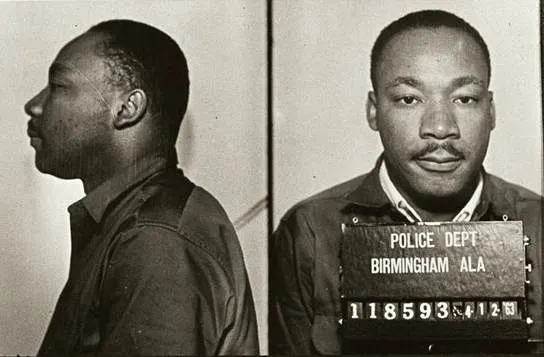
Martin Luther King, Jr., was arrested on April 12, 1963, for defying a Birmingham judge’s injunction against demonstration. He went to jail and was released on April 20, but only after he’d written the Letter from Birmingham Jail. It was one of 29 times that he was arrested.
By getting arrested, King and others in the civil rights movement joined the tradition of those in conflict with the state who went on to lead nations, to be revered by their fellow citizens, and to be commemorated in statues and streets and holidays. Only twenty years passed between King’s arrest in Birmingham and the the law establishing this day in his honor.
The bigoted regime that made King’s work necessary and the repression that led to his repeated arrest are American embarrassments. But it is significant that, even in the darkness of that time, it was possible for him to be arrested, to endure difficult conditions, and to emerge able to continue his fight. In another time and place, he would not have survived his first encounter with the state, and some of the activists around him did meet that fate. If that had happened, we might not remember him or enjoy his achievements.
There is a space where order and chaos blend into one another and coexist, where it is possible for the state to remain legitimate and strong even as its people openly defy it. It is not easy to find that balance, but democracy needs it to survive. King lived his life there. He loved his nation enough to fight for it and, when necessary, to fight with it.
The progress and growth of a civilization depend on that balance. It takes order to build but openness to find the path. These requirements are not limited to politics and activism. Artists who break convention, scientists who dispute common knowledge, and journalists who question power all drive the nation forward, and they depend on the balance to do it. When it’s lost, when we sacrifice openness for order, we achieve not strength but decay.
Renee Good was not arrested and she did not go to jail. Instead, when she challenged the actions of federal agents, she was executed in the street. Her killer was embraced by the President, his administration, and his supporters. The message was clear: there is no more balance. There will be no openness, and dissent will be strangled. Americans who disagree with the administration had already started to keep their opinions private. Now, activists who might have gone out to protest will have to reconsider whether they can risk the unaccountable violence they might encounter.
That message is spreading: scientists are finding their research scrutinized for ideological conformity, journalists are being censored. The consequences may not be fatal, as they were for Good, but they nonetheless close the space for dissent and debate. That will hurt all of us.
Today is a day to remember Martin Luther King, Jr.’s life and work. But it can also be a time to celebrate productive dissent in all its forms, and to commit ourselves to defending the openness that makes it possible.