I’m getting nervous about an encroaching optimism sneaking into the minds of Democrats. It’s not that they think Trump is going to do anything useful or even sane, or that they’re impressed with Democratic leaders. It’s that they believe that the American people are turning on Trump.
Here’s a data point. From Jamelle Bouie in the New York Times on Jan. 17:
For President Trump, the overall effect of the events of the past two weeks has been to pull his numbers even further into the inky depths of unpopularity. Thirty-eight percent of adults approve of the president’s performance, according to a Marist poll released this week; 56 percent disapprove. The Associated Press finds 40 percent approval and 59 percent disapproval, while Reuters reports 41 percent approval and 58 percent disapproval.
Not only is Trump deeply unpopular, according to a new CNN survey that similarly shows 39 percent approval and 61 percent disapproval — 58 percent of Americans say that the first year of his second term was a failure. On virtually every issue more Americans say that the president has made things worse rather than better, and large majorities say Trump has gone too far in the use of presidential power to pursue his own interests.
Roughly 40% is not the “inky depths” of unpopularity, for three reasons:
He’s still well ahead of Democrats
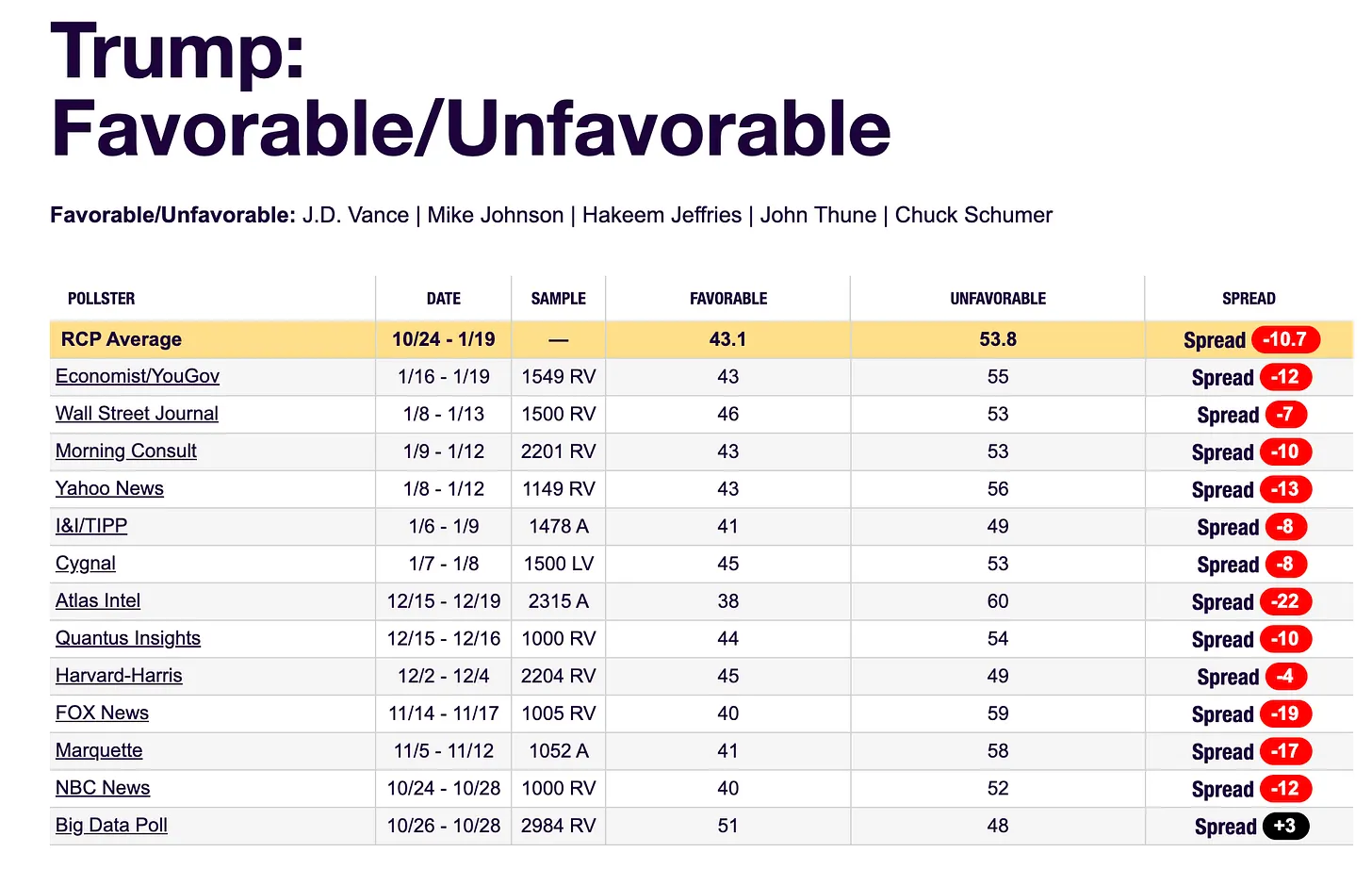
The latest RCP average puts Trump at 43.1 favorable:
And puts Democrats at 33.9.
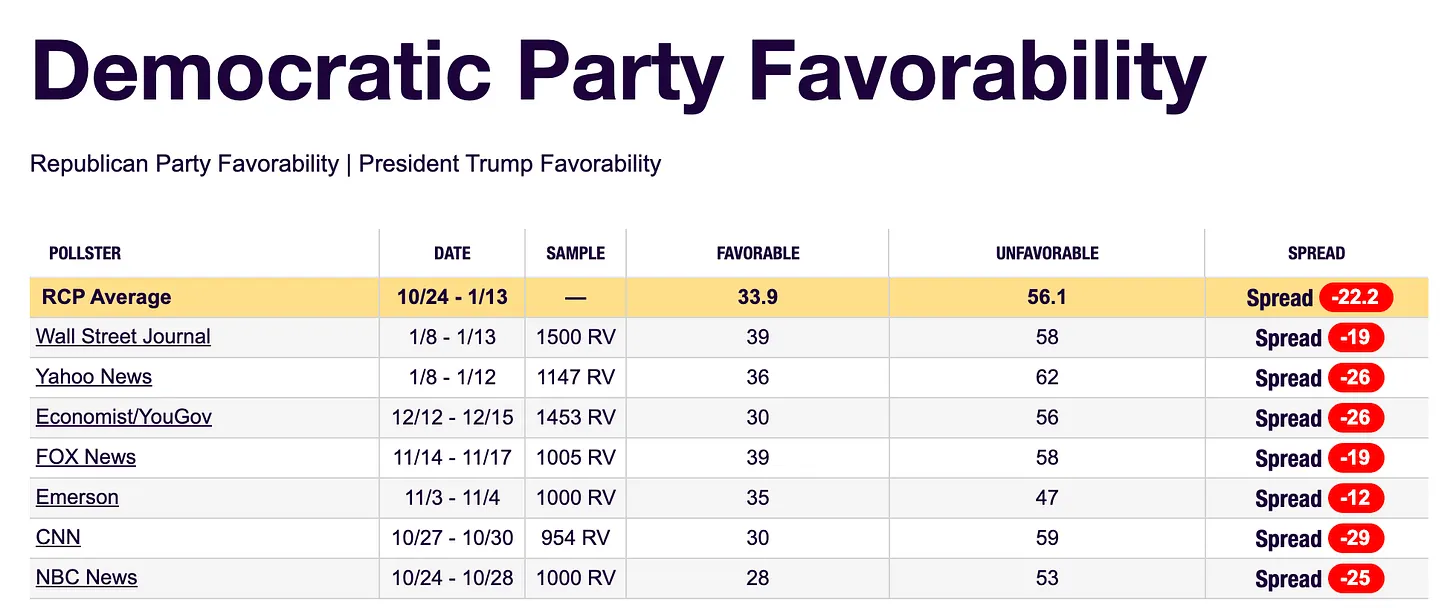
There’s no comfort in knowing that Americans don’t approve of Trump if they still strongly prefer him to the alternative.
My dad used to like an old joke that goes like this: two hikers in the woods see in the distance a bear break through the trees and start charging toward them. One takes off running, but the other calmly sits down and begins to change out of his hiking boots and into shoes better for running.
The first hiker calls back, “Are you crazy? We’ve got to outrun the bear!”
The second says, “No, I only have to outrun you.”
He’s been here before
40% is not historically low. Every president since Kennedy has been there, and a few have gone quite a bit lower.
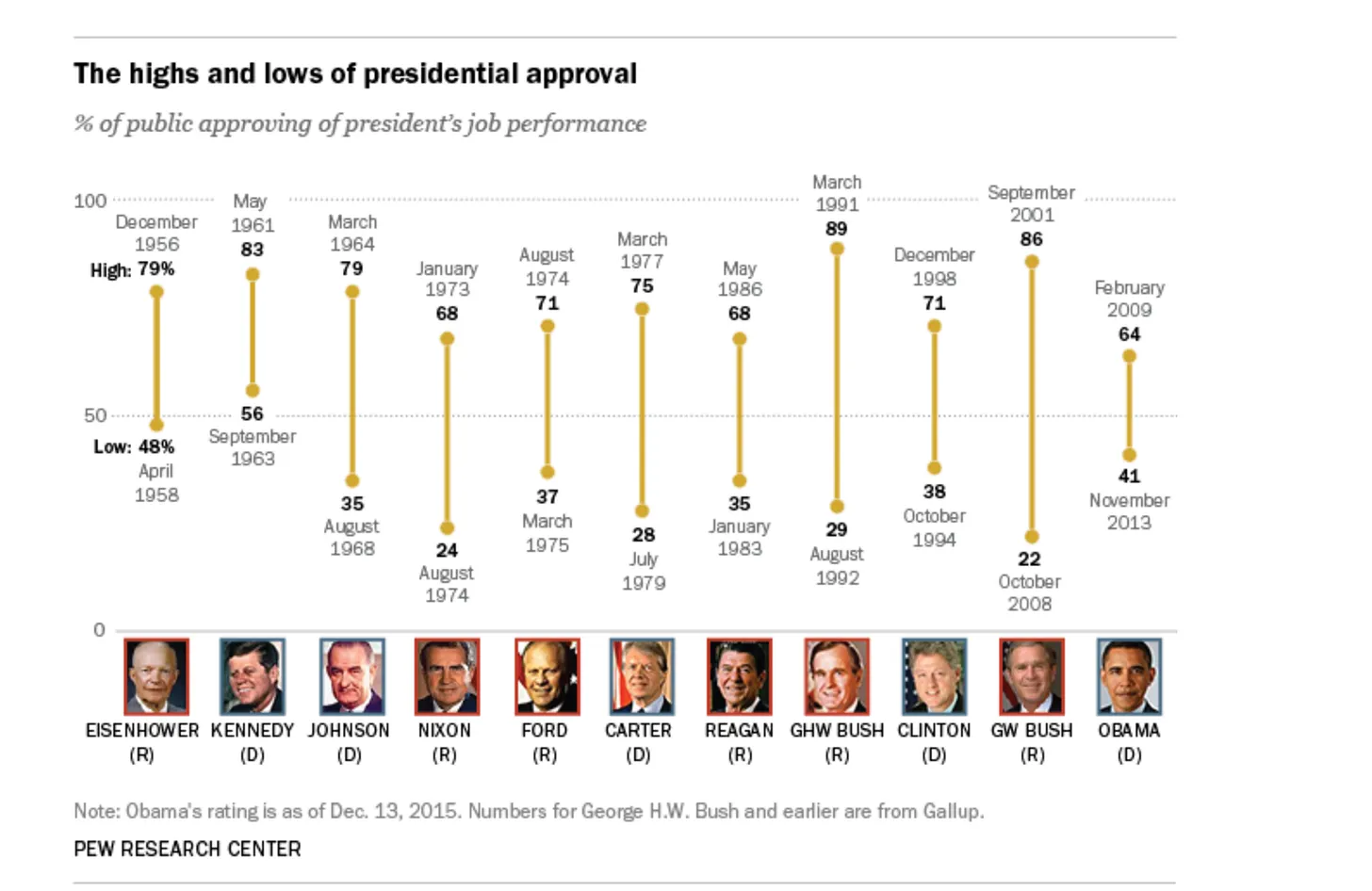
If you can, try to imagine the very worst moments of the George H.W. Bush presidency. What grave crisis was underway in August 1992 that led him to a 29% rating? Something worse than masked agents murdering Americans in the street, the abduction of a foreign head of state, or threats of invasion against European allies?
And—40% is not far from where Trump spent his first term.
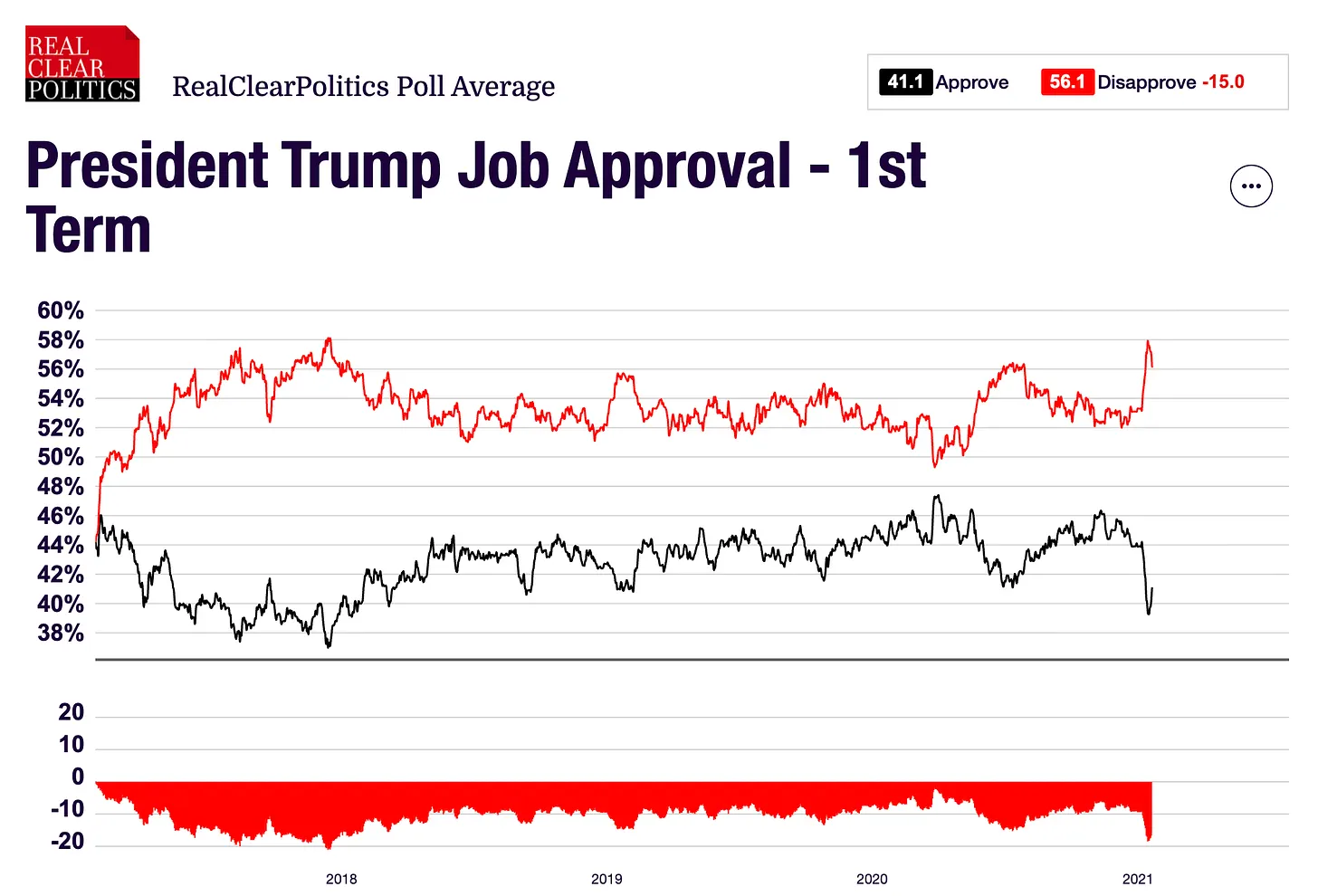
Yes, he lost in 2020. Then he came back stronger in 2024.
40% is not that low.
It’s a chilling number in absolute terms
If you spend enough time thinking about politics, you read these numbers a particular way. For instance, you know that about 30% will always approve and 30% will always disapprove, and so it’s all about the 40% in the middle that are reachable. So you can look at a 40 approve/60 disapprove split and say that in that reachable middle 40%, it’s 3-to-1 against Trump. That’s how you get to the idea that the approval of 40% of the nation is “deeply unpopular.”
But if you step back and read the number for itself, it says that after this year of relentless attacks on our Constitution, our economy, and our communities, you could take ten Americans at random and ask them how Trump’s doing, and four of them would give you a thumbs up. I don’t care how polarized we are—this presidency should not be able to break 10% approval in America. If we don’t see that, it’s only because we’ve baked dysfunction and polarization into the way we read the numbers. 40% is cause for alarm, not hope.
That brings me to the second data point. Here’s Jon Stewart on Jan. 18:
The institutions may be wanting, and may be failing, but the people aren’t. People keep saying, this guy’s Hitler. No he’s not, and I’ll tell you why he’s not: Hitler was popular. This guy’s not. …
It ain’t flying in a lot of places where you think it might be flying. So, the one institution that I think has been the bulwark in the way that nothing else has has been the people, and that’s been really heartening to me.
There’s something to that. The mobilization of people all around the country in resistance is inspiring. I’ve been to protests and whistle-kit drives and know-your-rights trainings; they’re happening everywhere here, and they’re powerful. And, it’s nice to hear anecdotal tales of conservatives and Trump supporters starting to question their support.
And yet: 40%. The people are the ones put him back in office, knowing everything we already knew by November 2024, and most of the ones who did still think that was a good idea.
I know now from talking to hundreds of people through the campaign that Democrats are desperate for hopeful signs. They see these approval ratings and want it to mean that Trump is weak. They ask leaders and candidates what they’re going to do to stop Trump, and those leaders oblige with pledges that they’ll never be able to keep. The emptiness of those promises should be evident, but people want to believe.
There is a difference between hope and wishful thinking. If I didn’t have the former, I wouldn’t be running. The latter is our biggest liability.
The crisis we face is not Donald Trump; he is symptom, not cause. The crisis is that our national values and civic commitment have degraded to the point that the people chose this and might very well still choose this. That won’t be solved by picking up a few seats in the midterms or holding hearings in Congress. The work is deeper and more difficult. We have to give the country a future to believe in, a shared purpose to rebuild a democratic culture around. We can do it, but we haven’t even started, and we won’t until we stop wishing that this is all going away soon.